 contextlake
The code graph model
Every node kind and edge kind the parser emits, language by language, plus Terraform, SQL and web topology.

Every node kind and edge kind contextlake kb index emits, and what each one is derived from.
This is the vocabulary the graph is queried in, so read it when a query returns nothing and you
need to know whether the thing you asked about is modelled at all.
After the general code model and its language table, eleven sections cover the sources the indexer reads beyond ordinary program text: Terraform, SQL DDL, XML Schema, XSLT, embedded SQL, decision records, entity state machines, intra-repo dataflow, constants, web topology and manifests. Each names what it extracts and, where the extraction is inferred rather than declared, says so.
What the graph captures#
Indexing builds a typed graph of your source. tree-sitter reads each file and pulls out:
- files, classes, functions and methods, interfaces, and imports
- an intra-repo call graph, so you can ask who calls what
- an inheritance graph (
inheritsedges forextends,implements, and base classes)
That last one means "what extends BaseController?" is a single hop, and changing a base class
shows its subclasses in blast_radius.
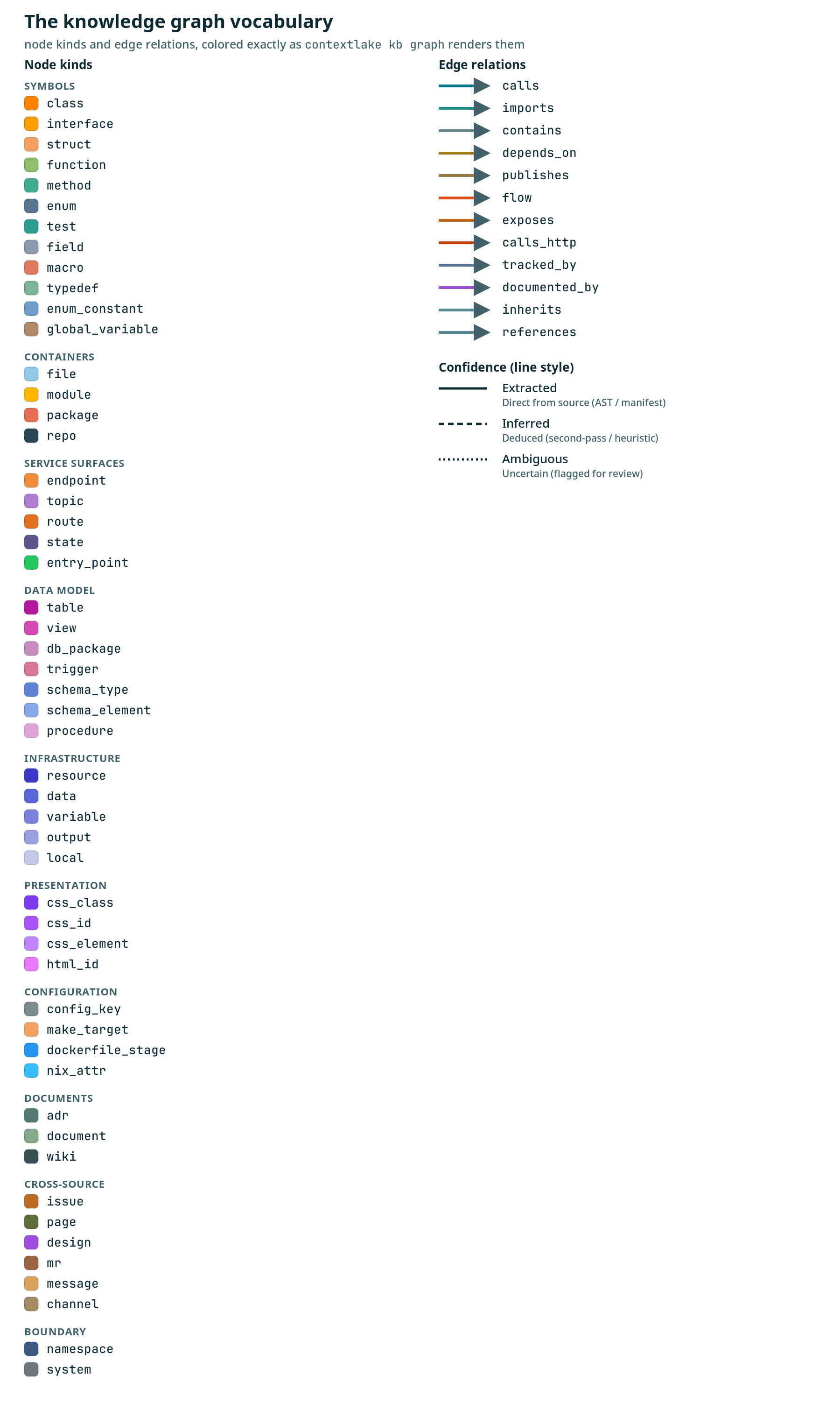
The diagram below takes its colours from the same module contextlake kb graph and the
dashboard use, so node kinds look the same everywhere. Most edge relations match too:
- 10 have their own colour:
calls,imports,contains,depends_on,publishes,tracked_by,documented_by,flow,exposes,calls_http - 2 use the default grey:
inheritsandreferences - 4 are real but not drawn:
reads,writes,usesandtransitions_to. This page covers them further down.
Languages#
tree-sitter covers 27 languages across 25 grammars (TypeScript and TSX share one grammar), and the parser registry is pluggable.
Depth differs across four tiers, and a single number would hide it.
| Tier | Languages | What you get |
|---|---|---|
| Full | C, C++, JavaScript, TypeScript, TSX, Python | definitions, imports, calls, plus module-level variables and class fields |
| Definitions | C#, Go, Java, Kotlin, Ruby, Rust, PHP, Scala, Swift, Dart, Zig, Perl, Bash, Elixir | definitions, imports and calls |
| Referenceable names | CSS, HTML, Nix, Make, Dockerfile | the names other files refer to: CSS class, id and element selectors; HTML element ids; Nix attributes; Make targets; Dockerfile build stages and the images they build on |
| Components | Svelte, Vue | each <script> parsed as JavaScript and each <style> as CSS, reported at their line in the file |
Most files reach a grammar by their extension. Build files have none, so they are matched by
name instead: Makefile, GNUmakefile, Dockerfile and Containerfile.
The match runs on the stem before the first dot. Makefile.am and Dockerfile.prod both hit.
MyMakefile does not.
Make targets are worth extracting because they are the names a person types at a shell and a CI job runs. That makes them the shortest answer to "what does this project expect of itself".
Not extracted: Make's own special targets (.PHONY, .SUFFIXES), and variables.
A Dockerfile gives you its build stages and the external images it builds on, kept apart. In
FROM builder AS test, builder is a stage declared earlier in the same file, not an image
anyone pulls.
COPY --from= references are not extracted. A stage name is local to its file, so resolving
those across files would wrongly link two unrelated builder stages.
The Dockerfile grammar is an optional extra, [kb-dockerfile]. Without it,
Dockerfiles are skipped and the run tells you which extra to install, rather than calling the
file unsupported.
On one public JavaScript tree, the full tier's extra kinds were 463 of its 783 nodes.
Two gaps, named here so you do not have to find them yourself:
- Zig types are not extracted. Zig declares a struct as
const Engine = struct {...}, which is a variable declaration, not a definition node. - HTML
class=attributes produce nothing yet. Aclass=is a use of a name some stylesheet defines, and that link is not emitted.
| Ecosystem | Languages |
|---|---|
| JVM | Java, Kotlin, Scala |
| .NET | C# |
| Web / JS | JavaScript, TypeScript, TSX |
| Systems | C, C++, Rust, Go |
| Scripting | Python, Ruby, PHP |
Frameworks are indexed through their base language: React / Next.js / Node.js are JS/TS(X), Angular is TS (its templates are HTML), and .NET is C#.
Missing yours? "Pluggable" is a literal claim: a language is a grammar package plus a few table entries. Adding a language is the ordered recipe, with the verification commands that prove a new grammar works.
C++ completeness#
C and C++ get extra handling, because both languages spread one thing across several files.
- A method defined outside its class (
ReturnType Class::method(...) { ... }, at any::depth) is attached to its class across the whole repo, not just the file it sits in. So an out-of-line definition still appears under its class, even when the class is declared in a different header. - A
namespace { ... }block is its own container, the same as a class or a file. - Headers (
.h) are parsed as C++. A class declared in a header and defined in a matching.cppshows up as one unit, instead of the class half going missing. .hfiles are indexed if either"c"or"cpp"is enabled. C and C++ headers are shared, so settinglanguages = ["c"]inkb.tomlstill picks them up. You do not need to list both.- Two definitions in opposite branches of one
#ifdef/#elsecollapse into one node. Without that, they would look like duplicate call targets.
Two things that deliberately do not collapse:
- A bare
#ifndefheader guard with no#else. Both copies sit in the same branch, so there is nothing to merge. - Genuine overloads, anywhere. They stay separate definitions.
If a C or C++ shard was indexed before these fixes landed, doctor flags it so you know to
re-index. See Health and maintenance.
Infrastructure: Terraform / HCL#
.tf files build an infrastructure dependency graph: resource / data / variable / output /
module / local definitions with depends_on edges resolving var. / module. / data. / resource
references across files in a repo. resource nodes are semantically searchable.
Resolution is repo-wide, so a block address defined identically in separate root-module directories (for
example environments/prod and environments/staging) surfaces as an AMBIGUOUS edge; directory-scoped
resolution is a future refinement. Render it with contextlake kb graph --repo <repo> --format
deploymentdiagram (a Mermaid flowchart grouped by inferred category: network/compute/storage/
database/security/other/module, where other catches any resource type none of the keyword lists
claims), see Visualize.
Databases: SQL DDL#
.sql files build a referential graph: table / view / procedure definitions with references edges
from foreign-key REFERENCES clauses, resolved across files in a repo. table and view nodes are
semantically searchable.
It uses a regex DDL extractor (the fleet's T-SQL/PL-SQL defeats a tree-sitter AST), so it targets the
high-value defs and FK references and is a deliberate undercount. Render it with
contextlake kb graph --repo <repo> --format erdiagram (a Mermaid ER diagram), see Visualize.
Measured, not asserted: tests/kb/fixtures/sql/ is a small, synthetic, hand-labelled
orders/customers/inventory corpus. It has a checked ground truth of every FK a human reading the DDL
would call real (expected_edges.json, 13 edges). tests/kb/test_sql_fixture_corpus.py scores the
parser's emitted references edges against it on every CI run, and asserts this page still quotes
what it measures.
Current numbers on that corpus: precision 1.00 (9 true positives / 0 false positives), recall 0.69 (9 / 13 ground-truth edges found). The corpus is small and hand-built. The numbers are no claim about the whole fleet, and they are real and reproducible.
Two documented gap classes account for the four missed edges, both by design, not bugs:
- A self-referencing FK (
referred_by/parent_category_id-style hierarchies) is dropped because the extractor excludestarget == name. - An FK attached via a separate
ALTER TABLE ... ADD CONSTRAINTstatement is never captured, because the scope tracker only scansREFERENCESinside aCREATE TABLE's own text span.
Precision was 0.90 on this corpus until the extractor learned to blank out -- and /* */ comments
before matching. Its one false positive was a commented-out REFERENCES line: dead DDL history that
resolved into a real-looking edge because the table it named still existed elsewhere in the repo. That
case is now pinned as a negative in the corpus test.
These are the numbers to distrust a graph INFERRED SQL edge by. The floors in the corpus test are
meant to be ratcheted up as the extractor improves, not treated as a target already met.
Data contracts: XML Schema#
.xsd files build a schema graph. Every global component becomes a node. Every name one
component gives another becomes a references edge, resolved across files in the repo.
Two node kinds:
schema_elementfor a globalxs:element. This is the name a message, a document root or a SOAP body carries, so it is the name people search for.schema_typefor a globalcomplexType,simpleType,group,attributeGrouporattribute. Which one it was is kept in theschema_constructattribute, rather than splitting these into five separate kinds.
Both are semantically searchable.
References come from type=, base=, ref=, itemType= and memberTypes=. The namespace prefix is
stripped first, since it is a per-file alias for a namespace URI: tns:PartyType in one file and the
<xs:complexType name="PartyType"> that defines it in another land on one node. The built-in
datatypes (xs:string, xs:dateTime, and the rest) are not references and are dropped, since they
name nothing the graph holds.
Three deliberate limits:
- Only global components are nodes. A locally-scoped
<xs:element name="Id"/>nested inside a complex type has no name anything can refer to, and minting one would put thousands of identicalIdnodes into a single schema set. A reference found inside one is attributed to the innermost global component enclosing it. - Schema names never resolve onto code symbols.
schema_typeandschema_elementare their own kinds rather than a reuse ofstructandtypedef, because reference resolution is by name across the repo: sharing a kind with C++ would lettype="Address"resolve, confidently and with nothing reporting the guess, onto an unrelatedstruct Address. .xsdnever reaches the XML config scanner.nameis one of that scanner's key attributes, so a schema sent there files every component as aconfig_keysetting.- Six extensions reach the config scanner, not just
.xml:.config,.props,.targets,.settingsand.plistcarry settings too, and.configis the canonical .NET one. Measured across 660 repositories, 1,023.configfiles were contributing nothing while being exactly the files "where is this setting defined" is asked about. .resx, project files and.svgare excluded on purpose..resxis localisation, and at roughly 22.9 settings per file across 3,963 files it would add about 91,000 nodes fleet-wide for translated labels nobody asks that question about..csproj,.vbprojand.nuspecare build definitions, which the manifest extractor already owns along with thedepends_onrelation that belongs between a build file and a package..svgis XML-shaped and is graphics.- A settings extension whose file is not XML costs nothing. The scanner is a regex over markup,
so an INI-style
.configyields no settings rather than raising.
Like the SQL extractor, this is a scanner rather than a tree parser, and for the same three reasons: entity expansion on untrusted mirrored input, hand-edited files a strict parser abandons whole, and line numbers the stdlib tree parsers do not report.
Transformations: XSLT#
.xsl and .xslt files build a stylesheet call graph. <xsl:call-template name="X"/> is a call
by name, so a stylesheet has one, and it was not in the graph at all before. Named templates,
match templates and xsl:function declarations are function nodes; top-level xsl:variable
and xsl:param declarations are global_variable nodes, which is a stylesheet's configuration
surface. $name reads become uses edges, attributed to the template they sit in.
A match template has no name to be called by, so its match pattern is its node name, with the
pattern and any mode recorded as attributes. It is not an identifier; it is the only handle
such a template has, and one with no handle cannot be pointed at from anywhere.
This adds no new node kinds, unlike XML Schema. The two choices look inconsistent, so here is why they differ.
- Schema references resolve on name alone, across the whole repo. A schema type called
structwould collide with C++. - Calls and variable reads are filtered by language family first.
xslis its own family, so anxsl:templatenamedformatcannot resolve onto a Pythonformat.
The isolation is already there, so no new kinds are needed.
Two limits, stated rather than left to be discovered. <xsl:import> and <xsl:include> are not
edges: the target is a relative href, and the only honest edge would point at a file node that
may not exist in the repository. XPath calls to an xsl:function are not edges either: the
function is a node, but the call sits inside a select expression and reading that needs an
XPath parser.
Embedded SQL: Pro*C#
.pc files are C with EXEC SQL statements written into the source. They are read twice, and
the split is the whole design: the C parse sees the file with every EXEC SQL statement
blanked out, and the dataflow pass sees it intact.
The mask exists because of a measurement.
Fed straight to the C grammar, EXEC SQL INCLUDE SQLCA; and EXEC SQL BEGIN DECLARE SECTION;
parse as declarations. That produces global_variable nodes called SQLCA, SQL and
SECTION. None of those things exist, and bare identifiers elsewhere in the repo would resolve
uses edges onto them.
Two properties keep the masking safe:
- It preserves length and newlines, so every line number the C parse reports is still real.
- It blanks only the statements. Host variables declared between the declare-section markers are ordinary C and stay in the graph.
The dataflow pass still reads the SQL, because the SQL is the whole point. What an EXEC SQL
statement exists to say is which tables the file reads and writes.
It normalises table names with the same rule .sql files use for their table nodes. So an
EXEC SQL SELECT ... FROM CUSTOMERS and a CREATE TABLE dbo.[Customers] in another file land on
one node, and that rule lives in exactly one place.
.pc follows C for language filtering rather than having a setting of its own. languages = ["c"]
in the [kb] table of kb.toml selects it, and languages = ["python"] does not. The filter is a
config setting, not a command-line flag.
Architecture decisions (ADRs)#
A repo's own decision records become adr nodes in that repo's shard, one node per file.
What counts as an ADR file: any .md file with a directory named adr, adrs or
decisions anywhere in its path, matched case-insensitively. So docs/adr/,
docs/decisions/, decisions/, adrs/ and architecture/adr/ all qualify.
Each node takes its title from the file's first # heading, or from the filename if there is
none.
Why ADRs are treated differently from connector content. An ADR is written by hand and checked into git. It is a recorded fact, so it needs no attribution or hedging. Content pulled from Jira or Figma comes over the network from a system this repo does not own, so it does.
What you get:
adrnodes are semantically searchable.- Their content feeds wiki generation as a grounded "Recorded decisions" section, cited next to the repo's other facts.
What you do not get: edges to other nodes. An ADR that mentions a class by name is not a verified reference the way an import or a call site is, so nothing is inferred from it.
Entity state machines#
A guarded assignment to a status, state or stage field becomes a transitions_to edge between
state nodes, labelled with the method that makes the change. For example:
if reading.status == Received: reading.status = Validated
Only guarded transitions are emitted. The source state has to be established by a comparison on the same field just before. That way a diagram never claims a transition the code does not make.
Supported in Python, JS/TS and C#. Detection is regex-based, so every edge is marked INFERRED.
Render it with contextlake kb graph --repo <repo> --format statediagram, which produces a
Mermaid state diagram. See Visualizing the graph.
transitions_to is deliberately not in impact's default relation set: unlike a table schema a
query depends on, a state value is rarely a thing other code breaks against when it changes (renaming an
enum member is a language-level rename, not a graph-discoverable break); pass --relation transitions_to
explicitly if you do want that walk.
Intra-repo dataflow: reads and writes#
Application code that queries a table it never imports still shows up in the graph.
A literal SELECT ... FROM, INSERT INTO, UPDATE ... SET or DELETE FROM inside a string
becomes a reads or writes edge, from the file to the table or view node the SQL DDL
extractor already found. This works in any language, because embedded SQL text looks the same
wherever it sits. Names resolve across the whole repo, the same way a foreign-key references
edge does.
A query against a table this repo never defines is left unlinked. That is an honest miss, not a guessed link.
reads and writes are in the default relation set for impact, so
contextlake kb impact <table> answers "what code touches this table" with no extra flags.
Constants: their value, and every place it is read#
A constant node records the declaration it was written with, so the graph answers what a value
is and not only that a name exists: MAX_RETRY = 3, PAGE_SIZE = 50,
#define TIMEOUT 30. It is stored as written, collapsed to one line and capped, and it is called
a declaration rather than a value because nothing has been parsed out of it.
Each place a constant's value is read becomes a uses edge from the file to the constant,
citing its own line. Like calls, this is stored once per occurrence, so "where is this read"
is answerable exhaustively rather than as one edge with an arbitrary line attached.
These are deliberately not counted as a use:
- the declaration itself
- a write, such as
TOTAL += 1orglobal TOTAL - an import
- an attribute, since
cfg.MAX_RETRYreads an attribute ofcfg
A bare name is also never matched against a class field. A data member is reached as self.x or
this->x, so a bare x is a local variable. On one public C++ tree, allowing that match
attributed 588 reads of a loop counter to a class member with the same name.
Where a name has several definitions, the edge is marked ambiguous rather than pointed at a guess,
and anything reporting a constant's use count should filter on confidence. uses is in impact's
default relation set, so contextlake kb impact MAX_RETRY answers "what depends on this value".
Web topology: endpoints and routes#
Two web-topology layers sit on top of the definitions.
HTTP endpoints a repo exposes or calls become shared endpoint nodes that join across repos into
flow edges, from the caller repo to the exposer repo. Detection is regex-based and framework-targeted,
so read the list as what is matched:
- Python: FastAPI and Flask decorator routing (
@app.get("..."),@router.route("...")). - JavaScript and TypeScript: the Express-shaped call form,
app/router/api/server.get|.post|.put|.delete|.patch("..."). Fastify code that happens to use one of those variable names is caught incidentally. NestJS is not supported: its@Controller/@Get()decorator routing matches nothing here. - C#: minimal-API
MapGet/MapPost/… and attribute routing,[HttpGet("...")]and[Route("...")], so a conventional MVC or Web API controller is picked up too. - Next.js App Router
route.tshandlers, via the file convention.
Every one of these edges is INFERRED by construction, a likely undercount rather than an assertion.
Frontend routes become repo-scoped, embeddable route nodes from three frameworks:
| Framework | Source | Normalization rules |
|---|---|---|
| Next.js App Router | app/**/page.* file convention |
route groups (name) dropped; dynamic [id] / [...slug] collapsed to {} |
| React Router | flat JSX <Route path=...> and the data-router object form createBrowserRouter([{ path, Component, children, index }]) |
index: true resolves to the parent path |
| Angular | Routes tables |
redirectTo skipped; lazy loadChildren captured as the mount path |
The object-literal forms use a tree-sitter AST walk anchored on the route-table container (a
Routes-typed declarator, or the array argument to RouterModule.forRoot / RouterModule.forChild /
provideRouter / create*Router), so
nested children compose into full paths and bare {path:...} config objects are never mis-read as routes.
Note
Skipped rather than guessed. Not yet extracted: Luigi navigation configs, Angular lazy
loadChildren sub-trees, React loader / lazy, realtime / WebSocket channels, templates, and
stylesheets.
Note
Shared nodes aren't owned by one repo. An endpoint/topic/module/package node's id
doesn't encode a repo: two repos that both import requests, call the same route, or publish
to the same topic produce the identical node, which the store dedupes to one row. Its repo
reads as a pseudo-repo ("(shared)", "(packages)") rather than any one real repo, by design:
which repos touch it is a question the cross-repo edges answer, not the node itself.
Manifests and cross-repo dependencies#
Indexing also reads manifests (pyproject.toml, package.json, *.csproj, pom.xml) to build a
cross-repo dependency graph through shared package nodes. Agents traverse all of this over MCP, from
finding a definition to cross-repo blast_radius ("what could break if I change this"); see
the full tool list under Serve.
Each depends_on edge records what the manifest says, not only the package name:
| On the edge | What it holds |
|---|---|
attrs["constraint"] |
the version as written, unparsed: >=1.9.0, ^4.17.1, [redis]>=5.0, or a whole environment marker. Absent, not empty, when the manifest pinned nothing. |
attrs["group"] |
runtime, dev, peer, optional:<extra>, or group:<name> for a PEP 735 dependency group, so an extra a user opts into is distinguishable from a dependency the package cannot start without. |
provenance.source_line |
the line the dependency was declared on, not the top of the file. |
The group vocabulary is the same across all four ecosystems, so nothing reading the graph needs to
know which one it came from: Maven's <scope>test</scope> and npm's devDependencies both read as
dev. Nothing interprets a constraint. Deciding whether an installed version satisfies ^4.17.1 is
a package manager's job, and the author's own text is the honest record of what was chosen.
The same change-impact walk is a one-liner from the shell: contextlake kb impact <symbol> [--hops N] lists
what calls / depends on a node, no editor needed. When a symbol name (e.g. Node, Forecast) is defined in
more than one repo, impact lists the candidates and you narrow it with --repo <repo> rather than
getting a silent best-guess.
$ contextlake kb impact queueJob --hops 3
Impact of changing queueJob (acme_alerts_queuejob): 3 affected node(s) within 3 hop(s)
  seed: function src/queueJob.js
  h1  acme/alerts:sendAlert  (function, src/sendAlert.js)  via calls at src/x:1  [extracted]
  h2  acme/alerts:AlertSender  (class, src/AlertSender.js)  via calls at src/x:1  [extracted]
  h3  acme/alerts:Notifier  (class, src/Notifier.js)  via calls at src/x:1  [extracted]
The graph, on this page#
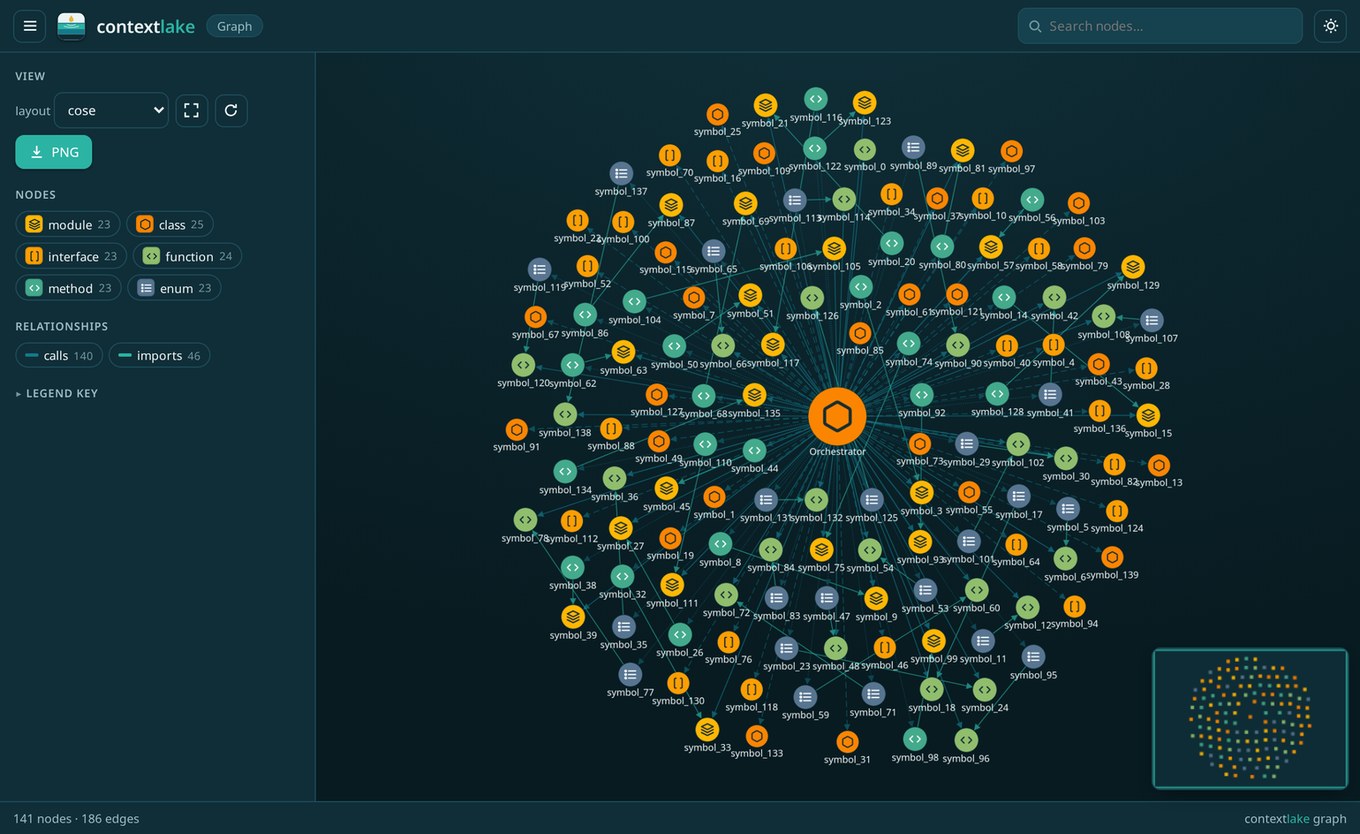
The model on this page, drawn. Node colour is the kind, edge colour is the relationship, and edge style is the confidence. It is the shipped visualizer, not a recording, and it runs offline with no network calls.