 contextlake
Indexing the code graph
Turn your mirrored repos into a queryable code graph: incremental indexing, and the full node and edge model across 27 languages, Terraform, SQL, and web topology.

Indexing turns your mirrored repos into a queryable knowledge graph. contextlake kb index --workspace
~/work walks every git repo under a folder and builds the graph. Runs are incremental by default;
--force rebuilds from scratch.
It also writes two documents per repository it indexed, <store>/docs/api/<repo>.md and
<store>/docs/design/<repo>.md, so a fresh index leaves a store you can read as well as
query. No model is ever run for them. A repository whose head commit has not moved since its
documents were written is skipped, so the cost of the per-commit hook stays flat. --no-docs
switches them off, and contextlake kb docs regenerates them unconditionally. See
Generate documentation.
A run over a seven-repository workspace. The live progress bar is redrawn in place, so what stays on screen is one line per repository and the summary:
$ contextlake kb index --workspace /tmp/work
Found 7 repositories under /tmp/work (incremental); indexing 7 with 8 worker(s)
✓ acme/alerts: 13 nodes, 13 edges
✓ acme/sensor-ingest: 12 nodes, 12 edges
✓ acme/console-ui: 16 nodes, 15 edges
✓ acme/station-registry: 10 nodes, 11 edges
✓ acme/shared-lib: 11 nodes, 8 edges
✓ acme/forecast-api: 9 nodes, 8 edges
✓ demo/app: 5 nodes, 4 edges
✓ Workspace indexed: 7 repos, 76 nodes, 71 edges (0 unchanged, 0 failed)
✓ Documents: 7 written, 0 unchanged, documents failed for 0 repo(s) → /tmp/work-kb/docs
flowchart TD
D(["a directory you point kb index at"]) --> B{"--bundle passed?"}
B -->|yes| ONE["indexed as one repository"]
B -->|no| G{"is it itself a git repo?"}
G -->|yes| ONE
G -->|no| S{"does it hold git repos, with
nothing of yours outside them?"}
S -->|no| ONE
S -->|yes| R(["refused, naming the command that fits"])
R -.->|"kb index --workspace"| EACH["each repo indexed under its own id"]
ONE --> GR[("the graph")]
EACH --> GR
The shape of the directory is measured before any of it is indexed, and the next section walks each outcome.
Which command for which directory#
kb index <dir> indexes that directory as one repository. kb index --workspace <dir> walks it
and indexes each git repository under it separately, under its own identity. Getting those two
the wrong way round is the most expensive mistake available here, so a directory that is not itself a
git repository but holds some is refused, with the command that fits what was found:
$ contextlake kb index ~/work
✗ /home/you/work isn't itself a git repo, but contains 20 git working tree(s) at depths 1-2
(alpha, beta, billing-core, frontend, gateway, …); no indexable file lies outside them.
That is a workspace mirroring several repositories. Indexing it this way files all of them
under ONE id, so every symbol they hold is in the graph twice and the copies cannot be told apart.
→ Run this instead, which indexes each repository separately under its own identity:
contextlake kb index --workspace
~/work
→ Or pass --bundle to index this directory as one repository anyway. …
It refuses rather than switching to --workspace for you, because switching can lose data.
--workspace indexes the nested repositories and nothing outside them. So on a tree of your own
loose sources that happens to carry a dependency with its own .git, it would index the
dependency and drop your files.
The shape is measured first: how much indexable content lies outside the nested repositories. Only then does it decide:
| What the directory looks like | What happens |
|---|---|
| Several repositories, effectively nothing of your own outside them | refused; run --workspace <dir> |
| One repository, nothing at all outside it | refused; the directory is one level too high, and the command names the repository |
| Real content of yours outside the repositories (your sources plus a vendored dependency) | indexed as one repository, with a line saying so |
A git repository (.git present), whatever it contains |
indexed, no diagnosis at all |
--bundle opts back in. It indexes the directory as one repository regardless of shape, and it
is read before anything is measured, so it always works. Reach for it when you want one
bundled repository -- and note the cost you are accepting: the nested repositories' files are filed
under the directory's name, so if you later index them properly they are in the graph twice. kb
forget <repo-id> removes a bundle you did not mean to create.
Incremental and time-travel#
index --workspace is incremental. It re-indexes only repos whose git HEAD moved since their
last index, so a scheduled run stays cheap.
--forcerebuilds everything.--watch [--interval N]keeps re-indexing in a loop. The same two flags also driveconnectandembed.
Every indexed snapshot is kept, which gives you time travel:
query "<text>" --repo R --as-of <commit> searches repo R as it was at a previously indexed
commit.
Re-indexing one repository by its id#
A repository's id is derived from its origin remote (so it survives being moved or re-cloned) and has
no relation to where the clone sits on disk. That is the id kb lint and the dashboard report, so
--source accepts it directly:
contextlake kb index --source example.com/team/widgets   # the id, exactly as reported
contextlake kb index --source widgets                    # the tail, when only one repo ends that way
The repository is re-indexed under the id it was already filed as, never a second time under its directory name. If the id is unknown, the error names near-miss ids from the store; if it is known but its recorded checkout is gone, the error names the path it was indexed from.
Use --repo to set the id explicitly, for a checkout with no usable origin or one you want
filed under a different name:
contextlake kb index --source ./widgets --repo team/widgets
Without it, the id falls back to the directory name. That is exactly the fragile, path-dependent
id this section exists to avoid. Name it once, rather than living with a repo filed as widgets
because that is what the folder happened to be called.
Parallelism and noise-pruning#
Repositories are parsed across worker processes (CPU-bound work) while the SQLite store is written
serially from the parent. The spawn start method is used on every platform, so behaviour is identical on
Linux, macOS, and Windows, with an automatic serial fallback if a worker pool can't start. It defaults to
cpu_count - 1 workers (capped at 8); set [kb] index_workers to tune it (1 forces serial).
The parser skips machine-generated and derived files. It skips a file when any of these match:
- a name like
*.designer.cs,*.min.jsorAssemblyInfo.cs - one of four header markers in the first 2048 bytes, matched case-insensitively:
<auto-generated,@generated,do not edit,code generated by - a size over
[kb] max_file_bytes, which defaults to 5 MB
The marker list catches more than it looks. A file whose banner only says "DO NOT EDIT" is skipped too.
All of that is derived noise rather than real source, and every skip is reported, so there
are no silent gaps. To index them anyway, set [kb] skip_generated = false or raise
max_file_bytes.
The per-repository memory budget#
max_file_bytes bounds one FILE. It cannot bound a repository that is wide rather than deep,
and that distinction is not theoretical: one repository in a 660-repo fleet took a 15.4 GB
machine down while its largest single file was 3.57 MB, comfortably under the 5 MB cap. The
cap never fired once. What broke it was 1,432 XML files averaging 0.42 MB, adding up to
671 MB.
[kb] max_repo_memory bounds the whole repository, and is checked before any file is
read rather than after a shard exists. It defaults to 3 GB. A repository whose estimate
exceeds it is skipped with its name, its estimated cost, and the file kinds that dominate,
and the rest of the run continues.
The estimate weights each file kind by measured cost per byte, because they differ by a lot:
| Kind | Peak memory per byte of source |
|---|---|
| code | 19.6x |
| SQL | 5.0x |
| XSD / XSL | 4.3x |
| XML | 3.5x |
Code is six times worse than markup, and the reason is edge count rather than node count: a sample of 5,738 C# files produced 82,000 nodes and 467,000 edges. So 400 MB of code is more expensive than 400 MB of XML, and a budget in raw bytes would refuse the wrong ones.
Two caveats worth knowing before you tune it:
- The estimate is linear and the real cost is not. Cross-file reference resolution grows with the number of symbols, so the estimate runs low on the largest repositories, which is where it matters most. Treat it as a coarse guard, not a prediction. The shard-item guard that runs after a shard is built is the second layer.
- This bounds one repository; a run's peak is this times the worker count. On a smaller
machine, lower
max_repo_memory,index_workers, or both.
Set max_repo_memory = 0 to disable the check.
Discovery also skips vendored nested repos: an upstream clone carried inside the mirror,
with its own .git, under a module-federation path segment. That is not your source, and
indexing it would flood the global graph with upstream demo nodes. Each skip is logged.
node_modules trees are pruned before discovery even descends into them.
To exclude your own paths, drop a .contextlakeignore at a repo's root. One glob per line;
# comments and blank lines are ignored.
Each glob is matched against the file's path relative to the repo, and against its name. So:
*.lockignores by name, anywhere in the repovendor/ignores that directory and everything under it
It is a small, dependency-free subset of gitignore syntax. No negation, no **, no anchoring.
Enough to drop vendored trees and lockfiles from the graph.
Health and maintenance#
contextlake doctor checks the environment: FTS5, git and glab on PATH, the store, the
embedder and the ANN index. It exits non-zero if anything is wrong, so it works as a CI health
gate.
It also flags any shard indexed with an older parser version than the one installed. That flag
is advisory and does not affect the exit code. contextlake kb index rebuilds those on its next
run, so they pick up parser fixes.
contextlake kb lint audits the graph itself. It reports:
- stale repos, where HEAD moved since they were indexed
- dangling edges, where an edge's endpoint node is missing
- the same older-parser repos doctor reports, so the two commands never disagree
- orphan vectors, where the semantic store holds vectors for a partition that has no nodes in the graph (see below)
- shared file nodes, where several files in the store share one file node (see Shared file nodes)
Both exit non-zero on problems. For lint that means dangling edges, HEAD-stale repos, or repos it cannot read.
The orphan-vector check is advisory too. For each partition that has vectors and no nodes, lint prints a line:
orphan vectors: <partition> (vectors with no nodes behind them, so nothing can reach them -- ...)
and the summary line ends with N partition(s) with orphaned vectors. Run contextlake kb embed
to rebuild them, or contextlake kb forget to remove them. Before 9.3.0 an interrupted
kb forget could leave this state. The check does not affect the exit code.
It runs only when [embeddings] is enabled and the vector store exists. Otherwise it reports
none. It also runs in the CLI only: the dashboard's lint view does not include it, because the scan
reads the vector store.
kb lint --json carries two fields for it, on every run:
| Field | Type | Meaning |
|---|---|---|
orphan_vectors |
number | how many partitions have vectors and no nodes; 0 when there are none |
orphan_vector_partitions |
list of strings | the partition ids, sorted; [] when there are none |
The older-parser count is reported but deliberately kept out of lint's exit code. Otherwise upgrading to a build with a new parser could turn a green CI gate red on its own.
Two states are reported apart from stale, because re-indexing clears a stale repository and cannot clear either of them:
- empty -- the repository has no commits at all, so there is no HEAD and nothing to index. Reported, and not counted against the exit code: there is nothing for a reader to do about it.
- shard-imported -- indexed from a graph-shard JSON rather than a checkout, so it has no history to be behind. Also advisory, for the same reason.
- unreadable -- the recorded path no longer exists, or git will not answer for a repository there. Re-clone it or drop it from the store. This one does fail the run, because nothing can be cited from it.
Shared file nodes#
Every file in the graph has a node. Its id is built from the repo id and the file path. The id
builder lowercases the text and turns every run of punctuation into one _. So these names get
the same id:
a-b.py,a_b.pyandA_B.pyin one repopkg/__main__.pyandpkg/main.pynumpy/_core/records.pyandnumpy/core/records.py- the repos
grp/a-bandgrp/a/b, for a file with the same path in both
The store keeps one row per id. The files share one file node, so all but one of them are missing from the graph as files. The symbols inside every file are still indexed. They hang off the one shared node.
kb lint names each such node, with the repo and every path it can see:
shared file node: <repo>: A_B.py, a-b.py, a_b.py share one node, so 2 of them are missing from the graph (known id limitation, see docs/indexing-the-code-graph.md#shared-file-nodes; not counted in this command's exit code)
When two repos share the node, the line says across repos and puts the repo in front of each
path. The summary line ends with N shared file node(s).
This is a known limitation of the id scheme. The check reports it and changes nothing. It does not affect the exit code. Re-indexing does not clear it. Renaming a file so that its name differs by more than case and punctuation, then re-indexing, takes that file out of the report.
The check is a lower bound. The tables keep a trace of a file only through its node row and its
contains edges. A colliding file that has no definitions, and is not the file the node row
names, leaves no trace, so lint cannot see it.
It runs in the CLI only, like the orphan-vector check. It reads SQLite, and the dashboard's lint view answers from a cache of the shards. On a synthetic store of 700,000 nodes and 1.7 million edges it took 0.45 s.
kb lint --json carries three fields for it, on every run:
| Field | Type | Meaning |
|---|---|---|
shared_file_nodes |
number or null | how many file nodes stand for more than one file; 0 when there are none; null when the check could not run |
shared_file_node_repos |
list of strings | every repo that shares a node, sorted; [] when there are none |
shared_file_nodes_sample |
list of objects | the first 20 findings. Each has node (the id), repos, cross_repo (true when more than one repo shares it) and files (a list of {repo, path}) |
The full node and edge model, language by language, is in The code graph model.
The graph, on this page#
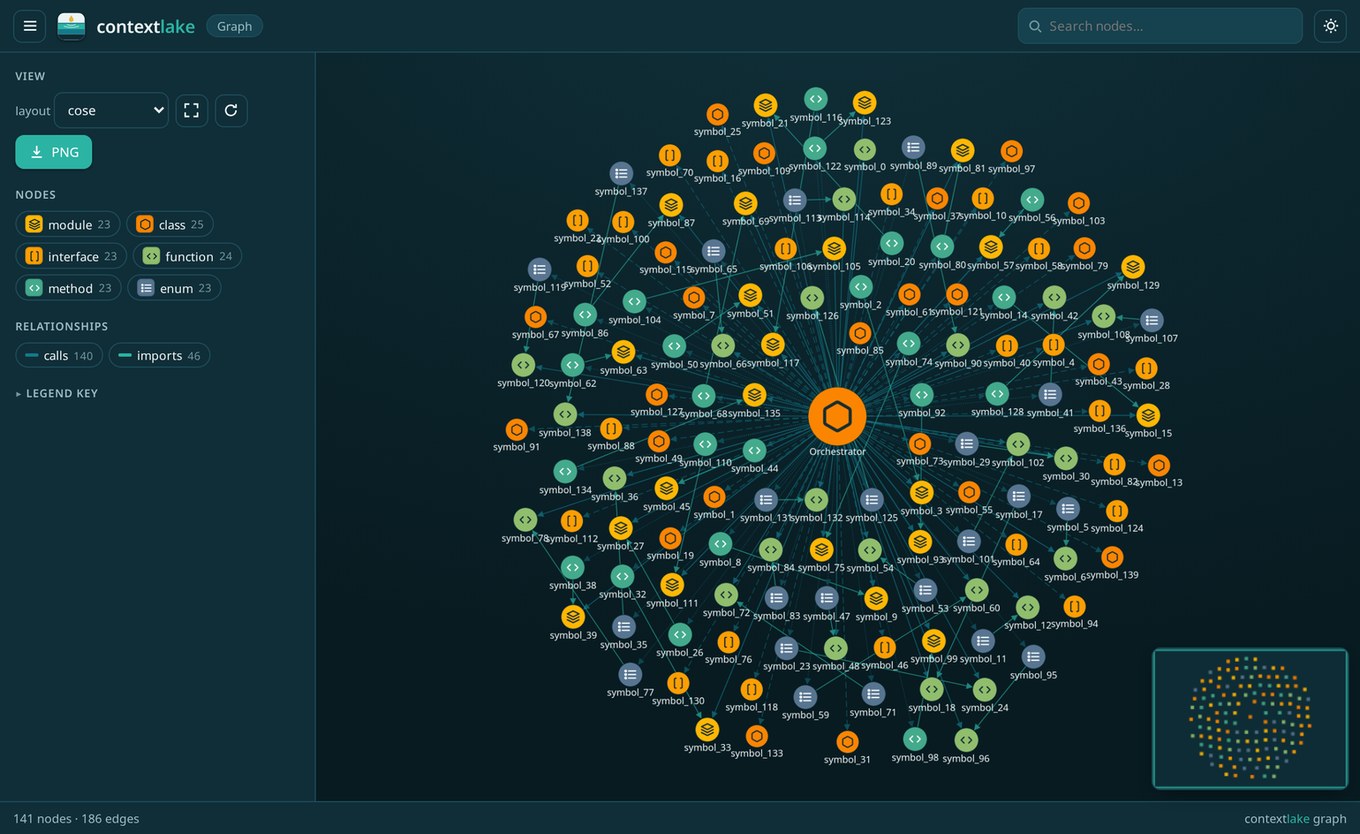
What an index produces. This one is contextlake's own repository, indexed by the commands on this page. It is the shipped visualizer, not a recording, and it runs offline with no network calls.