contextlake
Semantic search
Natural-language and hybrid graph-propagation retrieval: embed your code, tune the vector backend, and query across repos and languages.

Semantic search (optional) adds natural-language retrieval on top of the graph, so you can find code by
what it does even when you don't know its name. Enable [embeddings] in the config (local-first, vectors
come from an Ollama model by default, so code never leaves the machine), run contextlake embed to
vectorize the indexed nodes into a local store, and serve then exposes two retrieval tools:
semantic_searchfor queries where the exact symbol name is unknown.hybrid_search, which seeds Personalized PageRank with the embedding hits and propagates relevance across the graph (HippoRAG-style) to surface structurally related nodes, a function's callers, a package's dependents, that a pure semantic match would miss.
Backends and tuning#
The vector store uses an exact pure-Python cosine scan by default; install the optional ANN backend with
pip install "contextlake[kb-vec]" (sqlite-vec) for larger workspaces. Three [embeddings] keys tune it:
vector_backend(defaultauto) pickssqlite-vecwhen that extra is installed and falls back to the pure-Pythonbrutescan otherwise; force one withvector_backend = "sqlite-vec"or"brute".vector_chunk_size(the sqlite-vecvec0KNN chunk size, default 1024; clamped to a multiple of 8) is applied when the vector store is first created, so re-embed from scratch to change an existing store.batch_size(default64) sets how many nodes are embedded per batch.
What gets embedded#
The code definitions (classes, functions, methods, interfaces, structs, enums) and HTTP endpoints, each with its name, qualified name, file path, and captured signature and docstring, so a natural-language query like "refund a payment to the original card" finds the right function even when its name says nothing of the sort. (Measured on the golden-query harness, adding signature + docstring doubled MRR and took hit-rate to 100% on natural-language queries.) File, module, and package nodes are deliberately not embedded: a path or a shared package name is low semantic signal, and skipping them keeps results clean and avoids re-embedding cross-repo shared nodes once per referencing repo.
Which model?#
With that content embedded, the tiny static models punch far above their weight: on a 24-query
natural-language bake-off, the default potion-base-8M (~30MB, ~1ms per query) outscored the ONNX
bge-small transformer, and minishlab/potion-base-32M (~120MB, same engine and extra) scored best of
all, MRR 0.95 with a perfect hit-rate, at a tenth of the ONNX query latency. If you want the quality bump,
it's one config line: model = "minishlab/potion-base-32M" under [embeddings] (on a fresh vector store,
the identity guard refuses to mix models).
Like index, embed is incremental: it re-embeds only repos whose indexed HEAD moved since they were
last embedded, so a scheduled refresh over a large fleet stays cheap. Pass --force to re-embed
everything. When an upgrade changes the embedded text format itself, embed detects the stale store and
re-embeds everything once, announcing why, then incremental behavior resumes.
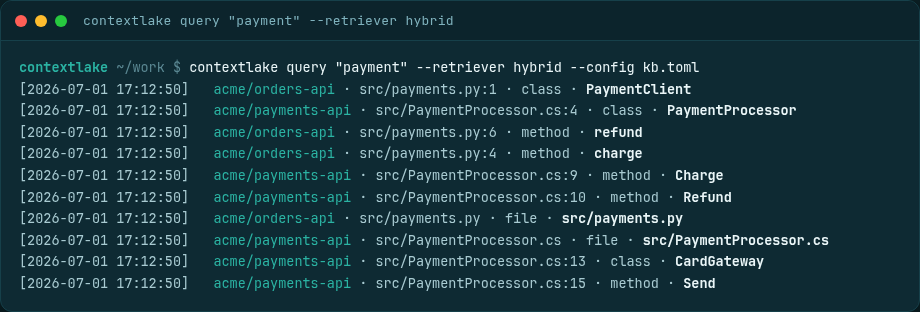
A single query returns cited hits (repo · file:line · kind · name) that span repos and languages, here
the C# and Python payment paths together. --retriever fts|semantic|hybrid picks keyword, vector, or
graph-propagation ranking: